
Marion County Bench Warrants
Marion County bench warrants are issued through the 5th Judicial Circuit Court when a person fails to appear for a court date or breaks a court order. The Clerk of Court in Ocala keeps records of all warrants filed in the county, and the Marion County Sheriff's Office runs an active warrant search tool on its site. You can look up bench warrants for free through the sheriff's online search or by reaching out to the clerk's office. This page covers how to find, check, and resolve active bench warrants in Marion County, Florida, along with key contacts and local resources that can help you take the right steps.
Marion County Quick Facts
Marion County Clerk of Court
The Marion County Clerk of Court manages all court case files, and that includes bench warrants. The office is at 110 NW 1st Ave., Ocala, FL 34475. You can call (352) 671-5604 for general questions about case status or to ask about a specific warrant. The clerk logs every bench warrant as soon as a judge signs it. These records are part of the public case file under Florida's Sunshine Law, Chapter 119. You can go in person during business hours to pull copies or get case details. The staff can search by name or case number. There is no charge to look up case info at the front counter, though copies of documents may cost a small fee.
The Marion County Clerk website is shown below and provides access to court records and case search tools.

If you need certified copies of bench warrant documents, call the clerk's office first. Ask about current fees and what forms of payment they take. Marion County bench warrant records go back years in the clerk's system, so even old warrants can be looked up through this office.
Marion County Sheriff Warrant Search
The Marion County Sheriff's Office is at 692 NW 30th Ave., Ocala, FL 34475. You can reach them at (352) 732-8181. The sheriff's office is the agency that serves bench warrants in Marion County. Once a judge signs a bench warrant, deputies are assigned to find and arrest the person named on it. Under Florida Statute 901.04, any sheriff in the state can serve a warrant from Marion County. That means a bench warrant issued in Ocala could lead to an arrest in Jacksonville, Tampa, or any other city in Florida. There are no geographic limits on when or where the warrant can be served.
The Marion County Sheriff's Office homepage is shown here.

The sheriff also runs an active warrant search tool on its website. You can search by name to see if there is an active bench warrant or arrest warrant in the system. The search is free and does not require you to log in or make an account. Keep in mind that the online list may not show every warrant right away. New warrants sometimes take a day or so to appear after the judge signs them. If you do not find what you are looking for online, call the sheriff's office directly.
The Marion County Sheriff active warrant search page is shown below.
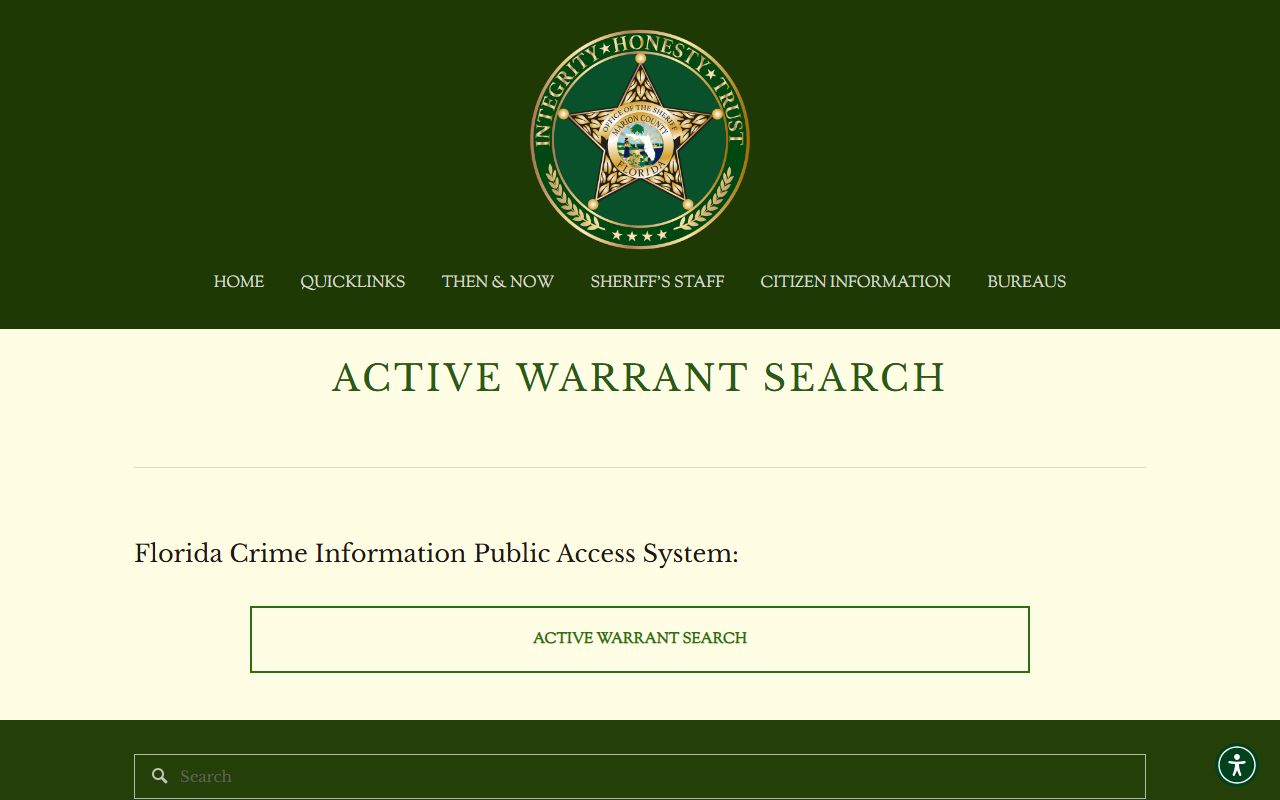
Results from the warrant search show the person's name, charge, and warrant type. This tool covers bench warrants, arrest warrants, and capias warrants for Marion County.
Marion County E-Warrant System
Marion County uses an electronic warrant system for both search and arrest warrants. Administrative Order M-2019-47 set up the procedures for how the system works. All law enforcement agencies in Marion County are trained on the platform, and judges use it to review and sign warrants digitally. Under Florida Statute 901.02, electronic signatures on warrants have been valid since July 1, 2013. This means a judge can approve a bench warrant without a physical signature on paper. The e-warrant system speeds up the whole process. It cuts down the time between a missed court date and the warrant going live in the system.
The state also runs the eWarrants platform through the Florida Court Clerks and Comptrollers association. This links police, state attorneys, clerks, judges, and sheriffs across all 67 counties. When a bench warrant is entered in Marion County, it shows up in statewide databases used by law enforcement everywhere in Florida. The FDLE updates its public warrant database every 24 hours, so a Marion County bench warrant will appear on the state system within a day of being issued.
Note: Marion County bench warrants do not expire and stay active until the person is arrested, the judge recalls the warrant, or the subject is deceased.
Bench Warrant Penalties in Marion County
Missing a court date in Marion County has serious consequences. Under Florida Statute 843.15, failing to appear on a felony charge is a third-degree felony. That carries up to five years in prison. Failing to appear on a misdemeanor charge is a first-degree misdemeanor, which means up to one year in jail. These are new charges stacked on top of whatever the original case was about. The bench warrant itself is just the mechanism the judge uses to get you back in front of the court, but the failure to appear charge is a separate criminal offense.
Bench warrants and search warrants are not the same thing. Search warrants expire after 10 days under Florida Statute 933.05. Bench warrants do not. A bench warrant from two years ago in Marion County is still valid today. It will come up if you get pulled over, try to renew your license, or have any interaction with law enforcement. The warrant stays in the system until it gets dealt with. Ignoring it does not make it go away.
Resolving Marion County Warrants
If you have an active bench warrant in Marion County, the best thing to do is talk to a lawyer. A criminal defense attorney can look at your case and figure out the best path forward. In some situations, they can file a motion to quash or recall the bench warrant. This is more likely to work for older cases or lower-level charges. Turning yourself in voluntarily tends to go better than getting picked up during a traffic stop or at your home. The Marion County Jail accepts voluntary surrenders around the clock.
Steps to deal with a bench warrant in Marion County include:
- Hire an attorney to file a motion to quash or recall the warrant
- Turn yourself in at the Marion County Jail
- Call the sheriff's office at (352) 732-8181
- Contact the clerk's office at (352) 671-5604 for case status
- Check the FDLE database at fdle.state.fl.us for statewide records
Watch out for scams. No one from law enforcement in Marion County will call and ask you to pay money over the phone to clear a bench warrant. If you get a call like that, hang up. Verify through the clerk or the sheriff's non-emergency line.
Note: Under Florida Statute 88.3051, a court can issue a bench warrant, capias, or writ of bodily attachment when someone does not appear after proper notice in Marion County.
Marion County Warrant Records Access
All bench warrants in Marion County are public records under Florida's Sunshine Law. Chapter 119 of the Florida Statutes makes most court records open to the public. You do not need to be a party to the case to look up a bench warrant. There are exceptions for juvenile cases and sealed records, but the vast majority of bench warrants in Marion County are available for anyone to search. Under Florida Rule of Criminal Procedure 3.730, the clerk or state attorney can prepare a direct capias to bring a person before the court. These documents are also part of the public record in Marion County.
Cities in Marion County
Marion County includes Ocala, Belleview, Dunnellon, McIntosh, and Reddick. All bench warrants in the county go through the 5th Judicial Circuit Court in Ocala. No city in Marion County has a population over 75,000, so all warrant matters are handled at the county level through the clerk and sheriff offices listed above.
Nearby Counties
These counties border Marion County. Make sure your bench warrant is in the right county before you take action. Each county has its own clerk and sheriff that handle warrants.