
Miami-Dade County Bench Warrants
Bench warrants in Miami-Dade County are issued through the 11th Judicial Circuit, which is the largest court system in Florida. With a population of nearly 2.9 million, Miami-Dade processes more bench warrants than any other county in the state. The Clerk of Court and Comptroller maintains a criminal justice online search tool, and the Miami-Dade Sheriff's Office handles enforcement. You can search for bench warrants through the clerk's CJIS database, by contacting the sheriff's records unit, or through the FDLE statewide system. This page covers the tools and steps for looking up bench warrants in Miami-Dade County and explains what to do if you find one.
Miami-Dade County Quick Facts
Miami-Dade Clerk of Court
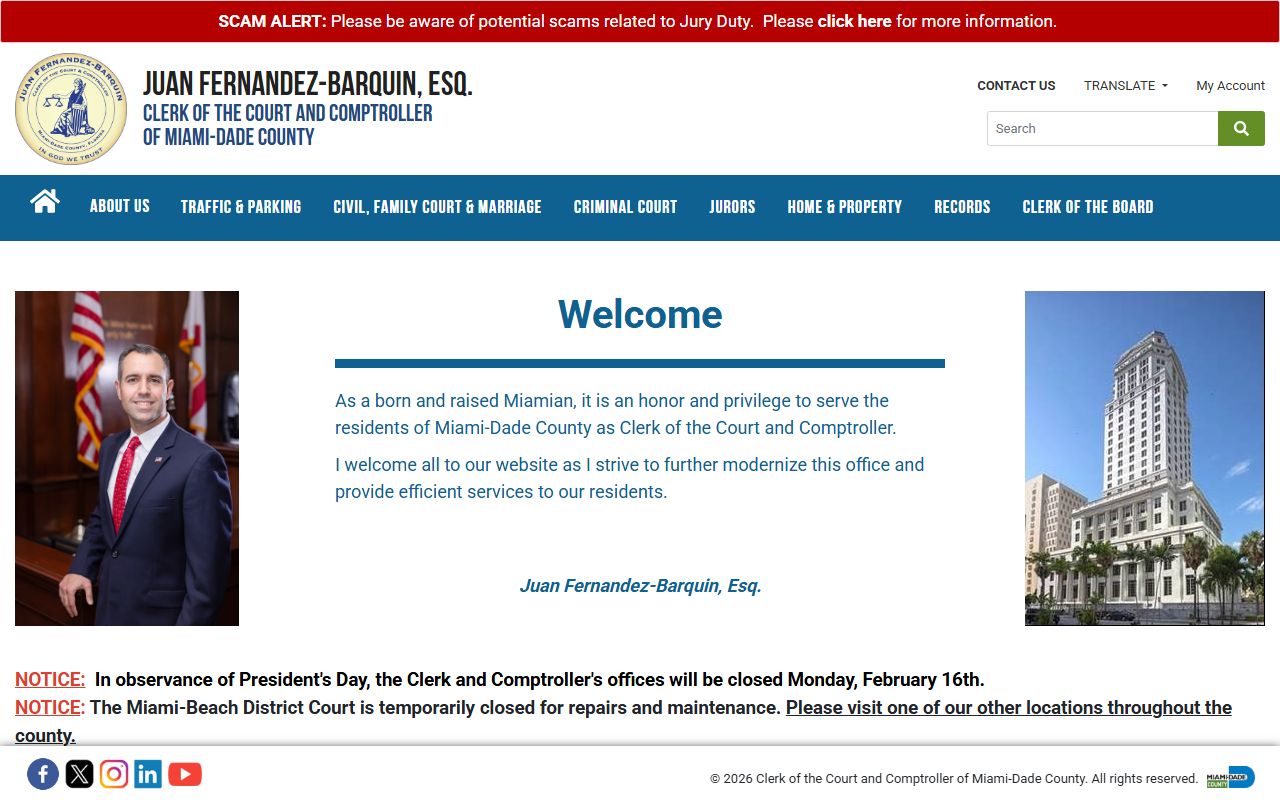
The Miami-Dade County Clerk of Court and Comptroller is headed by Juan Fernandez-Barquin, Esq. The main office is at 20 NW 1st Avenue, Miami, Florida 33128. You can call (305) 275-1155 for general questions. The clerk's office handles all court filings in the 11th Judicial Circuit, including bench warrants, capias warrants, and criminal case records. When a judge signs a bench warrant in Miami-Dade County, the clerk enters it into the system immediately. It becomes part of the public case file.
The Miami-Dade Clerk of Court website is shown below.
For public records requests, you can email cocpubreq@miamidadeclerk.gov or send a letter to Records Management, Miami-Dade County Clerk of Court, P.O Box 14695, Miami, FL 33101. The clerk's office also offers advanced searches for official records. Search units cost $1.00 each, and corporate or government accounts are available for high-volume users.
Search Miami-Dade Bench Warrants Online
The clerk runs the Criminal Justice Online Case Search (CJIS) database. This is the main tool for looking up bench warrants in Miami-Dade County. You can search by case number, state case number, citation number, defendant name, or jail number. The system is free to use and does not require any account or login. Results show case details, charges, hearing dates, and whether there is an active bench warrant or capias on file.
The Miami-Dade CJIS criminal justice search page is shown here.
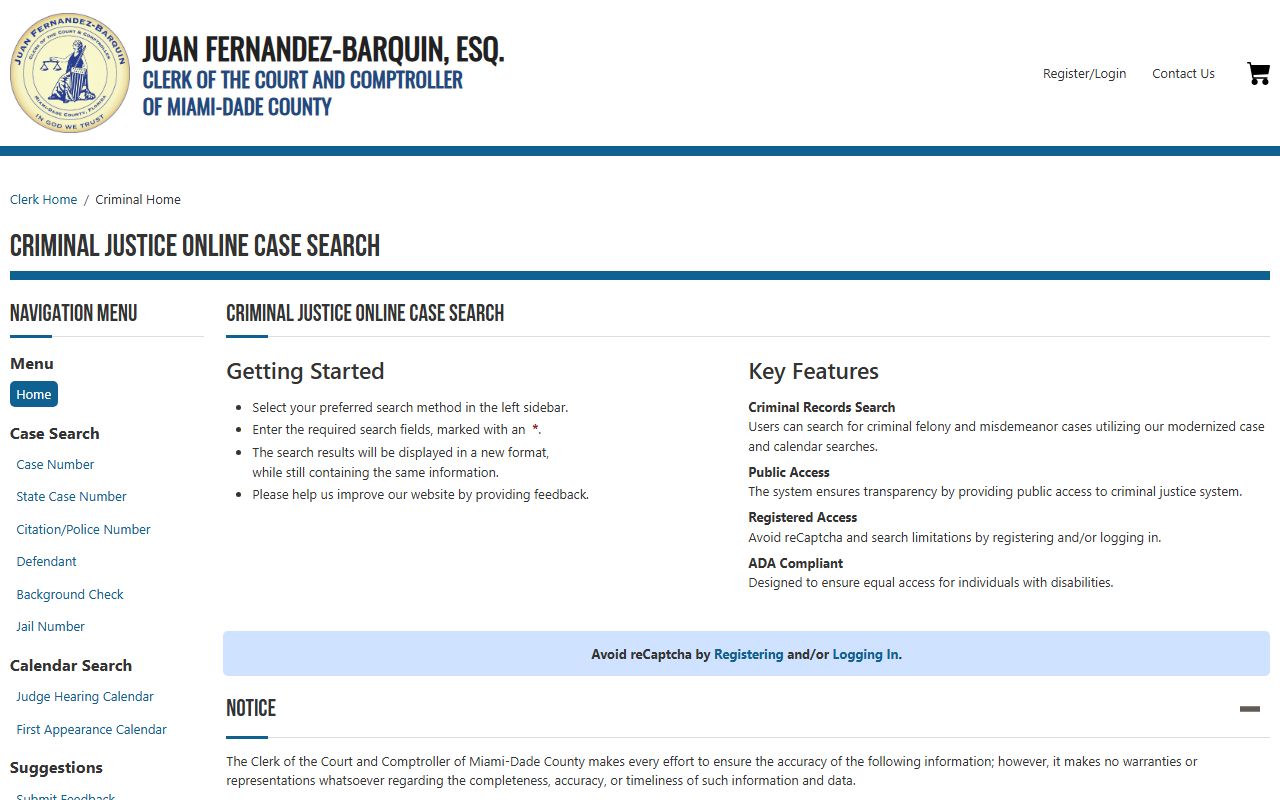
The CJIS database covers the entire 11th Judicial Circuit. That means bench warrants from any courthouse in Miami-Dade County will appear in the results. Given the size of the county, there are multiple courthouse locations, but they all feed into the same system. New warrants may take a short time to show up after the judge signs them. For the most up-to-date information, you can also call the clerk at (305) 275-1155.
Under Florida Statute 901.02, a judge must find probable cause before issuing a bench warrant. In Miami-Dade County, electronic signatures on warrants have been legal since 2013. This speeds up the entire process from the missed court date to the warrant being entered into the clerk's system.
Miami-Dade Sheriff Warrant Enforcement
The Miami-Dade Sheriff's Office is at 9105 NW 25th Street, Doral, FL 33172. Phone is (305) 471-3220, and the fax number is (305) 471-2072. You can email recordsrequest@mdso.com for records requests. The records request counter is open Monday through Friday, 9 a.m. to 4:30 p.m. An appointment is required for in-person visits. Walk-ins are not accepted. The sheriff's office handles the service of all bench warrants in Miami-Dade County, and their deputies are the ones who track down and arrest individuals named on active warrants.
Under Florida Statute 901.04, a bench warrant from Miami-Dade can be served by any sheriff in the state. The arrest can happen any day, any time. There are no restrictions. A bench warrant issued in Miami can lead to an arrest in Orlando, Tampa, Tallahassee, or anywhere else in Florida. The warrant data goes into the FCIC system, which links to the national NCIC database. So even traveling out of state does not keep you safe from a Miami-Dade bench warrant. If your name gets run during a traffic stop in another state, the warrant will show up.
Note: Miami-Dade County bench warrants do not expire and stay active until resolved through the court, the judge recalls the warrant, or the subject is deceased.
Bench Warrant Penalties in Miami-Dade
Missing court in Miami-Dade County is a serious offense. Under Florida Statute 843.15, failure to appear on a felony charge is a third-degree felony. That carries up to five years in state prison. Failure to appear on a misdemeanor is a first-degree misdemeanor with up to one year in county jail. These are new charges on top of whatever you were already facing. The bench warrant does not replace your original case. It adds to it. The judge can also revoke any bond you had posted, which means you might sit in jail until your hearing.
Search warrants and bench warrants are different things. Search warrants expire after 10 days under Florida Statute 933.05. Bench warrants never do. A bench warrant from five years ago in Miami-Dade is just as valid today. It will show up every time your name is run by law enforcement. The only way to make it go away is to deal with it through the court system.
Resolving Miami-Dade County Warrants
If you find out you have a bench warrant in Miami-Dade County, the smart move is to hire a lawyer. A criminal defense attorney who knows the 11th Judicial Circuit can review your case and figure out the best approach. Depending on the charge and how old the warrant is, your lawyer may be able to file a motion to quash. This asks the judge to cancel the bench warrant and reschedule your court date. It does not always work, but it is worth trying. Voluntary surrender is generally viewed more favorably by judges than getting arrested during a traffic stop or at your front door.
Ways to address a Miami-Dade bench warrant:
- Hire an attorney to file a motion to quash or recall
- Turn yourself in at the Miami-Dade County Jail
- Call the clerk at (305) 275-1155 for case status
- Email the sheriff's records unit at recordsrequest@mdso.com
- Check the FDLE database for statewide warrant records
Never pay money over the phone to clear a bench warrant. Scammers target Miami-Dade residents with fake calls from people claiming to be law enforcement. Real agencies will not demand payment by phone, gift card, or wire transfer. If you get one of these calls, hang up and call the sheriff's non-emergency line to verify.
Miami-Dade Warrant Records Access
All bench warrants in Miami-Dade County are public records under Florida's Sunshine Law, Chapter 119. Anyone can look them up. You do not have to be a party to the case. The Florida Court Clerks and Comptrollers association connects all 67 county clerk offices through the eWarrants system. When a bench warrant is entered in Miami-Dade, it shows up in statewide databases used by every law enforcement agency in the state. Under Florida Rule of Criminal Procedure 3.730, the clerk or state attorney can also prepare a direct capias to bring a person before the court for adjudication or sentencing.
Under Florida Statute 88.3051, a court can issue a bench warrant, capias, or writ of bodily attachment when someone does not appear after proper notice. In Miami-Dade County, the volume of these warrants is high given the population. The clerk's CJIS database is the fastest way to check. For statewide searches, the FDLE public access system pulls data from all counties and updates once every 24 hours.
Cities in Miami-Dade County
Miami-Dade County has dozens of cities and towns. All bench warrants go through the 11th Judicial Circuit. The following cities have populations over 75,000 and have their own pages with local details.
Other communities in Miami-Dade County include Coral Gables, North Miami, Aventura, Kendall, Cutler Bay, and Sunny Isles Beach. Bench warrants for residents of these areas go through the Miami-Dade County courthouse system.
Nearby Counties
These counties border Miami-Dade County. Confirm your bench warrant is in the right jurisdiction before taking steps. Each county has its own clerk and sheriff.